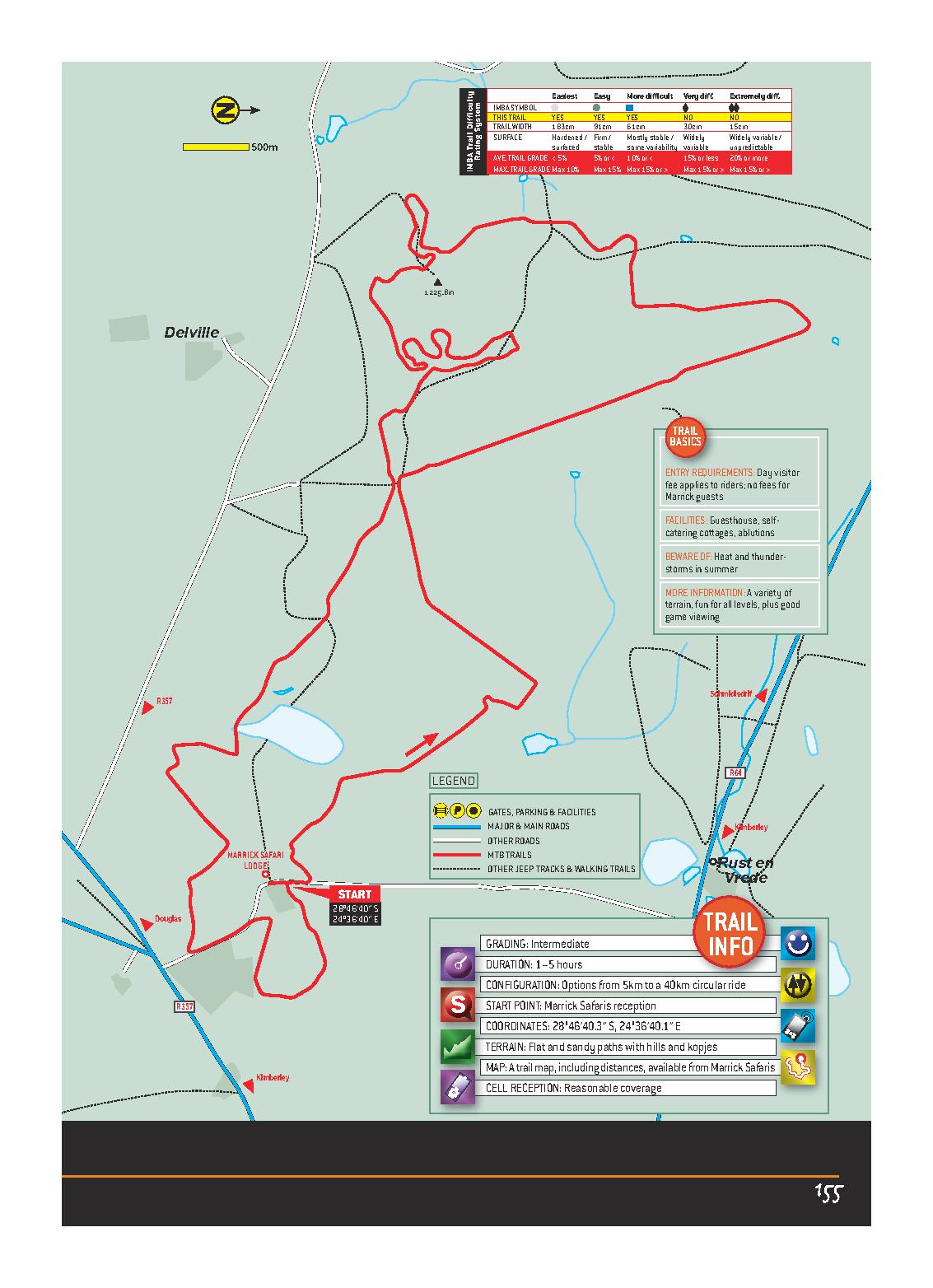
MARICK SAFARI LODGE

🏔️ TRAIL CONDITIONS TODAY Updated 9 hours ago · Northern Cape ⛅ 28°C Good conditions ✅ Good Conditions Good riding conditions expected today. CLICK TO DOWNLOAD PDF VERSION – Richtersveld National Park NORTHEN CAPE MTB ROUTES MAP PG159
The Kalahari Red Dune Route is the Northern Cape at its most raw and remote — riding through the classic landscape of the southern Kalahari, where red sand dunes covered with camel thorn acacia march north toward Botswana in long parallel ridges, separated by compacted inter-dune corridors of calcrete gravel that provide riding surfaces alternating between firm hard-pack and loose, wheel-grabbing red sand.
This is not groomed trail riding — the dune tracks are informal, the distances between water points are significant (carry minimum 4 litres per hour of riding), and the terrain requires a capable mountain bike with 2.2 inch or wider tyres for the sand sections. A fat bike is the ideal tool in the dune terrain. The rewards are extraordinary: the deep red of the dunes against a cobalt Kalahari sky, gemsbok running alongside the tracks, meerkat colonies watching from burrow mounds, and the complete absence of other humans that characterises the deep Kalahari between the small villages.
Critical note: The Kgalagadi Transfrontier Park itself — the adjacent cross-border national park — is NOT accessible by bicycle. Free-roaming lions, leopards and cheetahs make cycling inside the park boundary extremely dangerous, and SANParks does not permit it. The dune routes described here are on public roads and private farm land outside the park boundary — confirm the boundary before riding any route in this area.
Andriesvale and Askham are reached from Upington via Groblershoop and the R360 north (approximately 280-300km on gravel road). GPS for Andriesvale: -26.5667, 20.7833. High clearance vehicle essential — road conditions vary significantly after rain. Fuel at Andriesvale or Askham before riding.
35km of 4×4 track MTB through the Klein Koperberge granite peaks and desert plains of Namaqualand — quiver trees, halfmens succulents, Hartmann’s mountain zebra and a carpet of wildflowers in spring (August-September). Home terrain of the Namaqua Quest MTB Stage Race.
The Namaqualand Diamond Coast Bikepacking Route is the definitive multi-day cycling experience in the Northern Cape — a 400km loop that connects all the defining landscapes of the region: the N7 wildflower corridor, the Namaqualand copper mountain passes, the diamond coast ghost towns, the Cape fur seal colony, the Atlantic shipwreck coast and the remarkable frontier hospitality of Scott’s Seaside Inn at Port Nolloth. It can be ridden in either direction; the north-to-south clockwise version is described here as the preferred August-September wildflower season itinerary.
Day 1 — Garies to Kamieskroon (50km): North on N7 through the Anenous Pass approach — wildflowers on the farmland in season — to Kamieskroon. Overnight at the legendary Kamieskroon Hotel.
Day 2 — Kamieskroon to Namaqua NP and Springbok (90km): West to Namaqua NP Skilpad (peak wildflower day in season), then north through Namaqualand copper country to Springbok. Overnight in Springbok — resupply, rest, and an evening at a Springbok restaurant.
Day 3 — Springbok to Port Nolloth via Spektakel Pass (90km): North on N7 to Steinkopf, west on R382 over Spektakel Pass descending to the Atlantic coast at Port Nolloth. Overnight at Scott’s Seaside Inn — the most atmospheric overnight on the route.
Day 4 — Port Nolloth to Kleinsee (72km): South on coastal roads to Kleinsee — the diamond ghost town. Boulder Heritage Circuit, seal colony, Pink Salt Lake. Overnight in Kleinsee.
Day 5 — Kleinsee to Hondeklip Bay (35km + optional 37km shipwreck route): South to Hondeklip Bay via coastal road. Overnight at Honnehokke Resort — crayfish if in season.
Day 6 — Hondeklip Bay to Springbok via Messelpad Pass (104km): The hardest day — 104km on gravel, climbing the Messelpad and Wildeperdehoek passes back to Springbok through the copper mountain heartland.
Carry minimum 5 litres of water at all times on this route. Mobile signal is absent in many sections. Download the full GPX track and carry a paper backup map. A comprehensive repair kit is essential — the nearest bike shops are in Springbok and Cape Town.
Start: Springbok, 570km from Cape Town on the N7. GPS: -29.6641, 17.8866. Tel: +27 27 712 8035. Springbok is serviced by Intercape and SA Roadlink buses from Cape Town and Johannesburg.
The Namaqua National Park’s coastal section is the least-developed and least-visited part of the park — extending from the Skilpad plateau section all the way to the Atlantic coast in the Groen River area, where the succulent karoo biome meets the Benguela Current ocean in a landscape of extraordinary ecological richness and visual beauty. While the Skilpad plateau section draws thousands of spring wildflower visitors, the coastal zone remains largely undiscovered, its remote location (accessible via R362 and park roads from the N7) keeping it far quieter than any comparable coastal national park environment in South Africa.
The 35km gravel sprint from the N7 direction to the Groen River mouth follows the park’s gravel access road through the heart of the Namaqualand succulent karoo — an extraordinary ecosystem of quartz fields, endemic succulent groundcovers and specialised coastal fynbos found nowhere else on earth. The Groen River mouth opens onto a wild Atlantic beach: cold Benguela Current water, extensive tidal pools rich with marine life, and the sea mist that regularly rolls in from the ocean to create an atmospheric coastal environment completely unlike the sharp-lit dry interior just 20km behind you.
Practical note: The coastal section of Namaqua National Park is genuinely remote and the access infrastructure is basic. Contact SANParks Namaqua (+27 27 672 1948) to confirm current access road conditions and gate arrangements before visiting. Carry all food and water for the full day — no facilities on the coastal section.
Access the Namaqua NP coastal section via the R362 from the N7 (turn-off between Bitterfontein and Garies). GPS: -30.9167, 17.3833. Tel: +27 27 672 1948. From Cape Town: N7 north 530km to the R362 junction.
One of the most remote cycling destinations in South Africa — the Richtersveld is a UNESCO World Heritage Site and a mountain desert that has never been permanently settled, where quiver tree forests, river canyon landscapes and the Orange River border form an extraordinary but extreme bikepacking environment for self-sufficient expert riders.