
Stop Wasting Watts: How Race-Craft Analysis by e-fort AI Is Redefining Mountain Bike Performance
For decades, the standard formula for winning cycling races has been brutally simple: produce more watts. We obsess over Functional Threshold Power (FTP) , execute grueling interval blocks , and invest in lightweight carbon hardware, believing that sheer power output is the ultimate arbiter of speed. Yet, every weekend on Cross-Country Olympic (XCO) and marathon courses across the globe, riders with massive threshold power finish behind competitors who produce noticeably fewer watts.
Racing is not a controlled laboratory test. Power meters measure absolute energy expenditure, but they are blind to context. They cannot tell whether a 600-watt surge actually broke away from a rival or merely slammed a rider into a singletrack bottleneck. This critical gap between output and efficiency is where e-FORT AI focuses its race-craft analysis, challenging athletes to reconsider how they spend their energy on race day.
The True Cost of “Wasted Watts”
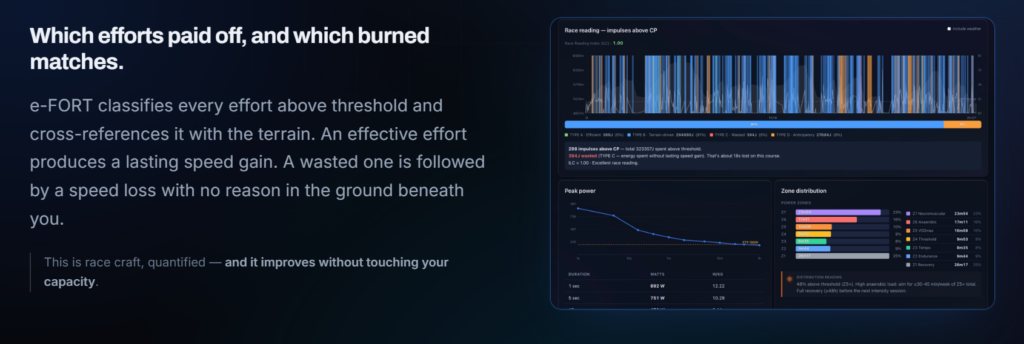
The central challenge on technical courses—from World Cup XCO circuits to local marathon trails—is the constant temptation to surge. A steep kicker appears, a gap opens, and the instinctive response is to punch over the crest. However, if that explosive effort leads straight into a technical descent or an immediate fire-road slowdown, that surge produced no real tactical advantage. It simply burned an anaerobic match that cannot be recovered.
Raw Power Output (Watts) ≠ Real-World Speed (Km/h)
Tactical Accelerations   → Yield Measurable Time Gaps
Wasted Surges            → Deplete Anaerobic Reserve (W') With Zero Speed Benefit
According to performance data evaluated by e-FORT, tactical discipline delivers quantifiable rewards. On a demanding 90-minute XCO course, eliminating just 15 percent of wasted efforts can save approximately 45 seconds—all without requiring the rider to generate a single additional watt of fitness. In modern mountain bike racing, where podium steps and overall titles are regularly decided by fractions of a second, 45 seconds is massive.
Anatomy of a Race Failure: Beyond the FTP Number
When an athlete “cracks” on a key climb late in an event, traditional post-race analysis usually falls back on vague explanations: poor fueling, high temperatures, or missing fitness. In reality, the breakdown is almost always mathematical and cumulative.
By aligning high-resolution power and cadence with course terrain and baseline recovery data, contextual AI reveals the specific inflection points where a race was lost:
Anaerobic Reserve Depletion : Premature accelerations on minor rises drain the rider’s high-intensity reserve before the decisive climb even begins.
Cardiac Kinetics & Residual Fatigue: Suppressed overnight Heart Rate Variability (HRV) compromises active recovery between surges, causing heart rates to spike earlier and stay elevated longer.
Contextual Debriefing: Rather than displaying generic averages, post-race diagnostics pinpoint the exact kilometer markers where unnecessary surges permanently drained physiological capacity.
Elite-Level Validation Across the Global Circuit
This shift toward tactical conservation is not merely a theoretical exercise. The methodology behind e-FORT’s race-craft engine has been refined across six seasons of international competition with elite athletes, including 2025 UCI World No. 1 and Cape Epic champion Candice Lill.
Furthermore, professional setups like Decathlon Ford Racing have adopted the platform across their multi-year campaign toward the Los Angeles 2028 Olympic cycle. In these high-stakes environments, winning does not always mean pushing harder—it means identifying and removing the inefficiencies that quietly erode a rider’s performance.
From Raw Data to On-Trail Intelligence
The era of merely logging numbers onto a head unit is coming to an end. Cycling technology is evolving from passive recording devices into proactive systems capable of understanding physiological limits in real time.
By understanding the difference between momentum-building surges and empty power spikes, riders can protect their reserves for the moments that truly matter. Ultimately, raw power will always be an asset on the bike, but in modern endurance racing, intelligence and race craft are what cross the finish line first.