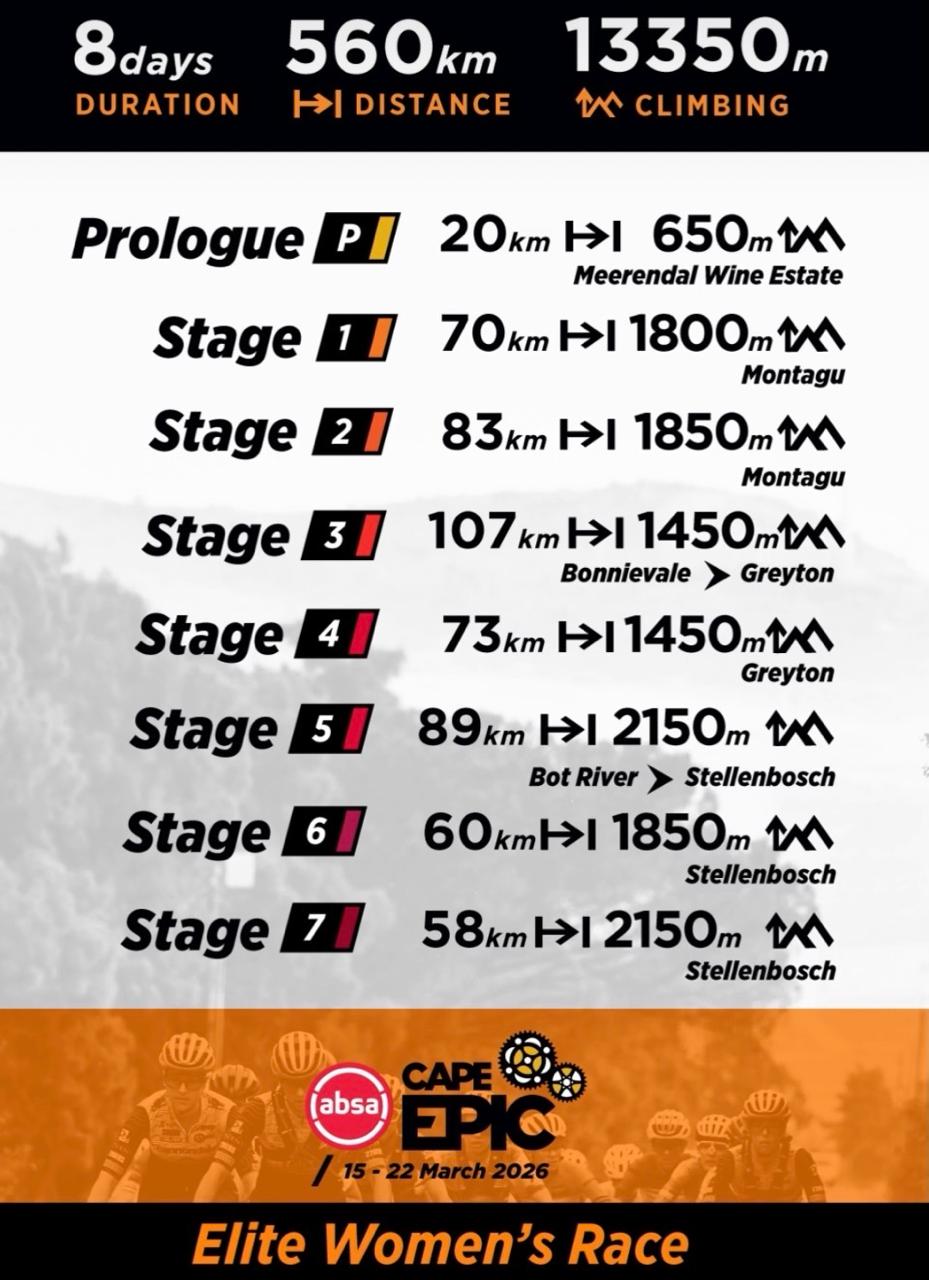
The Absa Cape Epic has never been afraid of evolution. Often described as the “Tour de France of mountain biking”, the eight-day stage race has long been a benchmark of endurance, resilience, and prestige. For 2026, however, the organisers have announced one of the most significant changes in the event’s history a redesigned women’s race featuring shorter stages.

While the adjustment may seem subtle on paper, its implications for elite women’s racing are profound. The move signals a deliberate effort to align the Cape Epic more closely with the modern demands of professional cross-country racing and, crucially, to bring the world’s best UCI XCO riders back to the start line.
Why Distance Matters in Modern XCO Racing
Elite women’s mountain biking has changed dramatically over the past decade. Today’s top XCO athletes are not just endurance specialists; they are explosive, highly trained competitors who peak multiple times across a tightly packed international calendar.
The 2026 WHOOP UCI Mountain Bike World Series calendar reflects this reality. With nine rounds of XCO and XCC racing spread across three continents starting in early May and concluding in October athletes must carefully manage training load, recovery, and global travel.
2026 UCI Cross-Country World Series Calendar highlights:
- May 1–3: South Korea
- May 22–24: Nové Město Na Moravě, Czechia
- June–July: Austria, Switzerland, Italy, Andorra
- August–October: France, USA
- UCI MTB World Championships: August 26–30, Val di Sole, Italy
For many elite riders, the Cape Epic sits uncomfortably close to the opening World Cup rounds. Historically, the marathon-length daily stages often exceeding four hours delivered a massive endurance training signal. While that volume suits marathon specialists, XCO riders frequently reported needing weeks to fully recover, compromising early-season World Cup form.
In a discipline where margins are measured in seconds and peak power outputs, that level of fatigue can derail an entire campaign.
A Smarter Fit Into Training Blocks
By shortening women’s stages for 2026, the Cape Epic now fits far more cleanly into XCO training structures. Rather than acting as a season-disrupting overload, the race can function as a high-quality intensity block one that builds durability, race sharpness, and technical skill without excessively draining anaerobic capacity. For XCO athletes balancing international travel, altitude exposure, and short-track explosiveness, this matters. The revised format acknowledges that women’s elite racing is no longer about simply surviving distance, but about optimising performance across a global season.
In practical terms, it means a rider can race the Cape Epic in March, recover effectively, and still line up competitively for the opening World Cup in May without sacrificing early results or risking overtraining.
Reversing the Decline in XCO Participation
In recent years, one trend has been impossible to ignore: fewer pure XCO specialists have taken part in the women’s Cape Epic. While the men’s race continued to attract a broad mix of marathon and Olympic riders, the women’s field became increasingly dominated by endurance-focused teams. That shift wasn’t due to lack of interest or prestige the Cape Epic remains one of the most valuable titles in the sport but rather a reflection of physiological and calendar realities.
By adjusting stage distances, the Epic organisation appears to be directly addressing this decline in participation. The aim is clear: increase the number of competitive women’s teams and re-establish the event as a must-race for the world’s best all-round mountain bikers.
A Win for Competition and Visibility
The impact of this change extends beyond elite athletes alone. A deeper, more diverse women’s field elevates the entire race. Closer racing, tactical battles between XCO stars and marathon specialists, and recognisable World Cup names all enhance the spectacle for spectators, media, and sponsors alike. It also sends an important signal about the future of women’s racing: that parity does not always mean identical formats, but rather intelligent design that allows athletes to perform at their best within the realities of their discipline.
Innovation That Protects the Race’s Legacy
The Cape Epic has always prided itself on being brutally hard, but also on being relevant. By evolving the women’s race format, the organisers are protecting the event’s long-term status as a pinnacle of professional mountain biking rather than a niche endurance outlier.
Shorter stages do not dilute the challenge. Instead, they sharpen it, encouraging higher race intensity, stronger competition, and broader participation. In doing so, the 2026 Cape Epic may well mark the beginning of a new era for women’s stage racing: one where endurance, speed, and season-long performance finally coexist.
If the goal was to bring the world’s best women back to the Epic start line, this change feels not just timely, but inevitable.