
The Shocking Truth About the Cape Epic Broadcast
Women’s Racing Already Gets 87% Parity — And 2026 Could Change the Game Forever
For years, debates about equality in sport have often focused on prize money, participation, and media coverage. In professional cycling, however, one race has quietly been rewriting the rules long before equality became a fashionable talking point. The Absa Cape Epic, often described as the “Tour de France of mountain biking,” has been one of the global leaders in building genuine equity between men’s and women’s racing.
First came equal prize money in 2014 — a landmark decision at the time. Then came a separate start for the elite women in 2016, allowing the women’s race to unfold tactically rather than being influenced by amateur men’s teams on course. Now, with the release of new broadcast analysis data from the 2025 edition, another surprising story has emerged.
Even with a race format where the men finished significantly earlier, women’s racing still received an impressive 45% of total tagged broadcast coverage, producing an average Equity Score of 87 out of 100. (Data from analysis of Cape Epic 2025) For a sport broadcast traditionally dominated by men’s racing, that number is remarkable. But the real story might be what happens next. Because in 2026, the race is introducing a new format designed to bring men and women across the finish line within minutes of each other — potentially creating the most equitable mountain bike broadcast ever seen.
A Race That Has Led the Way
Long before discussions about equal coverage became common in cycling, the Cape Epic had already begun reshaping the landscape. The race’s decision to introduce equal prize money in 2014 sent a strong message to the sport: women’s racing deserved equal recognition. But the organizers didn’t stop there.
Two years later, the event created a dedicated elite women’s start, ensuring that the women’s race could unfold as a true competition rather than being influenced by faster amateur riders from the men’s categories. This change dramatically improved the integrity of the race itself, allowing elite women to compete head-to-head in a clean tactical environment.
Yet the move created a new and unexpected challenge. A challenge that would only become clear years later when analysing broadcast data.
The Finishing Gap Problem
In the 2025 Cape Epic (as in all previous editions), both elite men and elite women raced the same distance on every stage. Because the men’s field is generally faster over long distances of technical terrain, they typically reached the finish line 30 to 45 minutes before the women. From a sporting perspective, this was completely fair — both races covered the same terrain and distance. But from a broadcast perspective, the timing created a problem.
The men’s finish usually occurred during the most intense part of the live broadcast. Cameras, commentators, and viewers were fully engaged as riders sprinted for the line. However, by the time the women arrived at their decisive moment — often 30 minutes later — some viewers had already tuned out. The natural broadcast climax had already happened. This phenomenon became known internally as the “finishing gap.” And it showed up clearly in the data.
Measuring Broadcast Equity
To better understand how the broadcast covered both races, analysts used a subtitle-based commentary analysis system. The process works like this: Every segment of commentary in the broadcast subtitles is scanned for keywords identifying men’s or women’s racing. For example:
- Women’s keywords include references like “women,” “women’s,” or athlete names such as Tessa Kortekaas, Candice Lill, Vera Loser, Anika Langvad, Bianca Haw, Haley Hunter Smith, and Sofia Gomez Villafañe etc
- Men’s keywords include names like Nino Schurter, Matt Beers, Keegan Swenson, and Filippo Colombo etc
Each segment is categorized as:
- Women
- Men
- Both
- Neutral
Only the segments specifically referencing men’s or women’s racing are counted when calculating coverage share. The resulting Equity Score measures how close the broadcast comes to a perfect 50/50 split.
A score of:
- 100 = perfect parity
- 70+ = good balance
- 50 = moderate imbalance
The results from 2025 were revealing.
The 2025 Broadcast Numbers
Across the entire race week, the broadcast delivered an average Equity Score of 87 out of 100.
That translates to 45% of race-specific coverage focused on women’s racing.
Considering the timing challenges caused by the finishing gap, that figure is surprisingly strong.
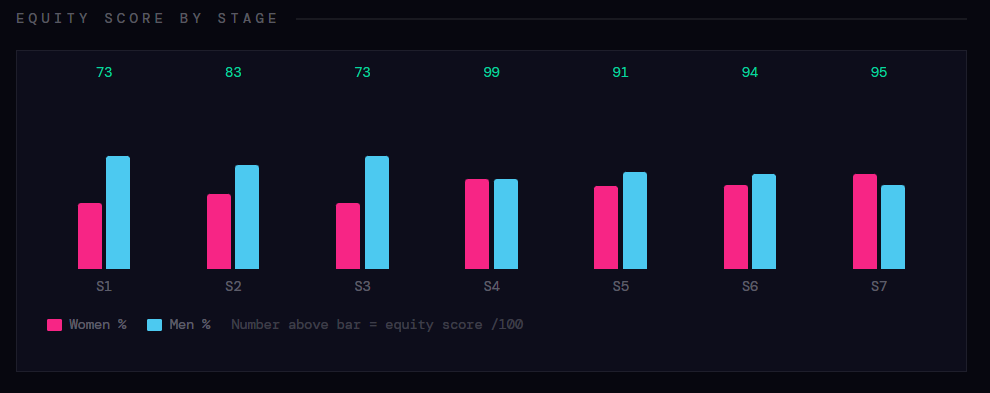
Here’s how the stages performed:
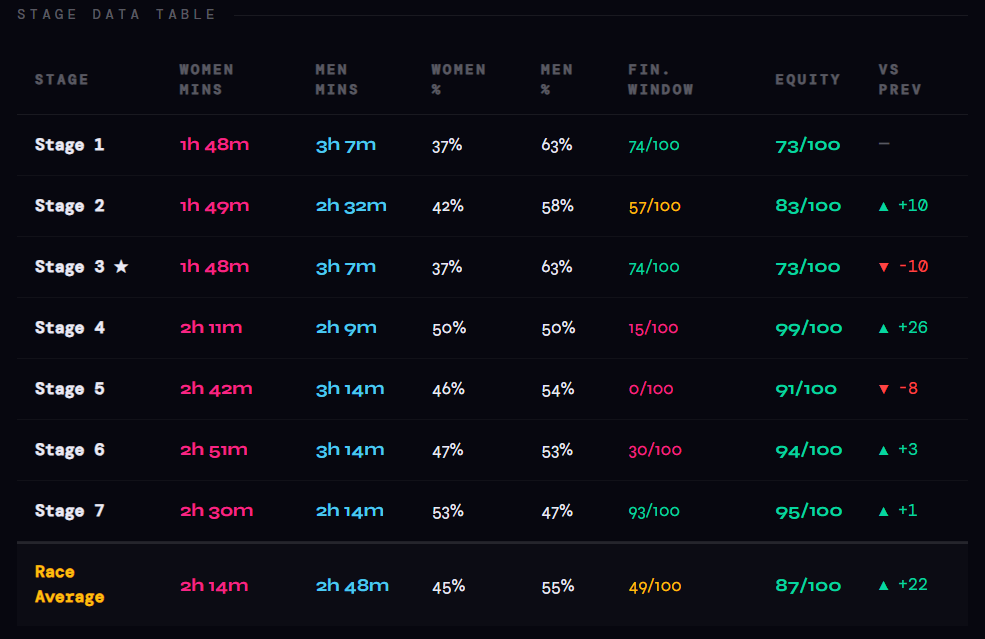
The pattern tells a fascinating story.
The Hidden Challenge: Viewer Drop-Off
The data also highlights the structural challenge of the current format. Because the women often finish 30 minutes after the men, some casual viewers leave the broadcast before the women reach the finish line. That means the women’s race can be unfolding in front of a smaller audience — even when the coverage itself is balanced. In other words: The broadcast team was doing its job. But the race format itself created a viewership bottleneck.
Enter 2026: The Time Parity Revolution
For the 2026 edition of the Absa Cape Epic, race organizers are introducing one of the most innovative changes in the history of mountain bike stage racing. For the first time, elite women will race a slightly shorter route, designed specifically to align their finishing times with the men’s race.
The aim is simple:
Bring both races to the finish line within the same broadcast finishing window.
Instead of the women arriving 30–45 minutes later, both races will reach their decisive moments within minutes of each other. Why This Could Transform Women’s Racing. The potential impact is enormous.
If both races are reaching the final kilometers simultaneously or within minutes of each other, the broadcast can showcase:
- Two tactical battles unfolding at once
- Split-screen race finales
- Shared finishing drama
- Equal podium exposure
Imagine the closing moments of a stage.
On one side of the screen, Matt Beers is attacking on a technical descent. On the other side, Candice Lill is preparing for a sprint finish. Instead of cutting away from one race to show another, viewers can follow both battles simultaneously.
For fans, it’s twice the excitement.
For sponsors, it’s twice the exposure.
Why Sponsors Are and Should Pay Attention
Broadcast equity isn’t just about fairness — it directly affects sponsorship value.
More visible racing means:
- More airtime for team sponsors
- Greater athlete recognition
- Stronger commercial returns
When brands see their athletes competing in front of a global audience, investment in women’s teams becomes more attractive. That creates a virtuous cycle:
More visibility → more sponsorship → stronger teams → better racing.
The Cape Epic’s new format could accelerate that cycle dramatically.
A Model for the Future
What makes the Cape Epic unique is that it hasn’t waited for the sport to change.
Time and again, the race has been ahead of the curve. First with equal prize money. Then with a separate women’s start.
Now with a race format designed specifically to achieve broadcast parity. We await the format that the ABSA Cape Epic will introduce to ensure higher viewership numbers. Few events in global cycling can claim such a consistent record of leadership.
The Next Chapter
When the 2026 Absa Cape Epic rolls out of the start chute, it will mark more than the beginning of another brutal week of racing. It will mark the start of a new experiment in sports broadcasting. If the timing works as planned, fans could witness something unprecedented:
Two world-class races reaching their climax together. Two battles for victory unfolding similar finishing window. And perhaps — for the first time — a mountain bike broadcast where women’s racing occupies the same spotlight as the men’s in viewership numbers.
If the numbers from 2025 already reached 87 out of 100, the question now becomes tantalizingly simple:
How close can the race get to perfect parity?
The answer might arrive at the finish line — with two champions crossing it just minutes apart.